Isle of Iona
Iona is thought to be the first Christian site in Scotland. As such, this tiny island (1 mile wide, 3.5 miles long), now in the care of the National Trust for Scotland, is very popular with pilgrims and the thousands of tourists who come to visit the Abbey in the summer months.
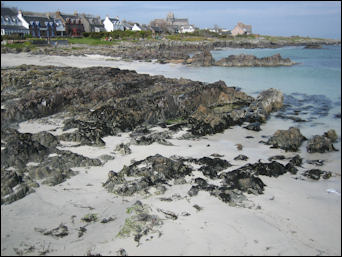
If you want to feel its magic, the best time to be on Iona is either early in the morning or in the evening to avoid the hundreds of day-trippers who pour off the ferry every day. If the area around the Abbey gets too busy for you, then find one of Iona's sandy beaches and relax. The south and western parts of the island are not so well visited, but well worth seeing.
How to get to Iona
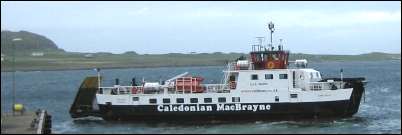
Caledonian MacBrayne operates a small passenger ferry between Iona and Fionnphort on the southern tip of the Isle of Mull. It runs back and forth throughout the day and takes 5 minutes. The cost of a return ticket is around 3 pounds. Bicycles are carried for free.
Photo copyright 2008 The Internet Guide to ScotlandSea.fari Adventures (Oban) offers a direct service to Iona from Easdale (south of Oban) by rigid inflatable boat (with cabin seating) in just 75 minutes. This 6-hour trip allows ample time ashore on Iona, plus a non-landing trip to Staffa (Fingal's cave). Visit Scotland 4 star wildlife trip boat operator. Tel: 01852 300003.
The drive to Fionnphort through the mountains and lochs of southern Mull is very inspiring in itself. There are regular buses from Craignure on the east coast of Mull connecting with the ferries arriving from Oban on the mainland.
Throughout the tourist season there are daily coach day-trips to Mull, Iona, Staffa and the Treshnish Isles from Oban, click here for details.
You can also get a boat trip to Staffa direct from Iona.Charter a traditional wooden open boat Freya - boattripsiona.com. Max 11 passengers. Operates mid April - late September. Scheduled boat trips (up to 3 hours) also operate on certain days. Contact Mark Jardine. Tel: 01681 700537.
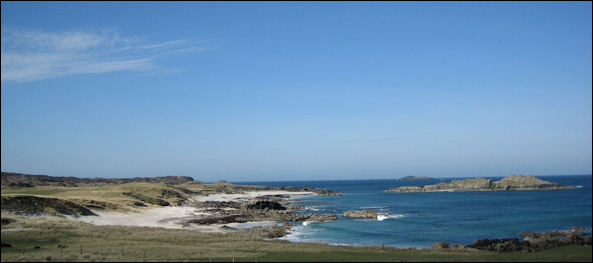
Beach at the north end of Iona - photo copyright 2010 The Internet Guide to ScotlandTravellers' Tips
If you are unable to walk the quarter of a mile to the abbey, you can hire the Iona Taxi. Contact Lindsay and Joyce McIntyre - telephone 0781 032 5990 - advance booking is essential. Pickup from ferry at Craignure also available. Or try Blazing Saddles Cycle Hire at Seaview Guest House in near the ferry at Fionnphort (Mull). Tel 01681 700 235.
The Oban Times has a free tourist map of Mull & Iona which you can download online (PDF).
The Iona Community Council has a useful web site for visitors: welcometoiona.comA list of accommodation is provided at the end of this page.
The Findhorn Foundation owns a retreat house on of the island of Iona - for details click here.Historic Sights
 |
 |
 |
 |
| Photos copyright 2009 The Internet Guide to Scotland | |
|
Iona Nunnery
Iona Heritage Centre
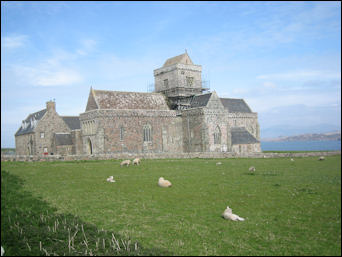
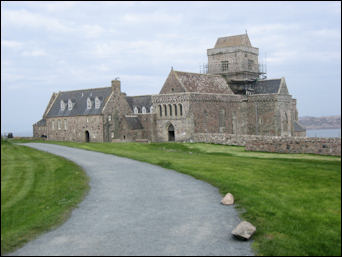
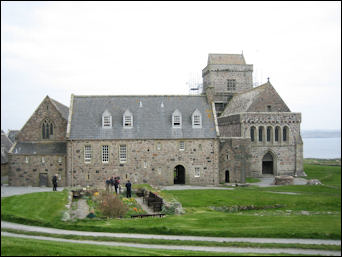
Iona Abbey
The number of visitors has increased to a level which the island can barely sustain (reports speak of 150,000 people a year).
Some visitors also come to see the resting place of the late Labour Party leader John Smith who was given special permission to be buried here in the Abbey cemetery in 1994. His daughter was later married in the abbey.
The Columba Centre was opened by Historic Environment Scotland in Fionnphort on Mull in 1997 as part of the commemorations for the 1400th anniversary of Columba's death. Currently not open. There are several good craft/gift shops and a book shop on Iona - click here for a list.
A very useful biography was written about Saint Columba just a century after he died. It was produced by the Irish monk who became Saint Adomnan and can be bought online as a Penguin Classics paperback. |
|
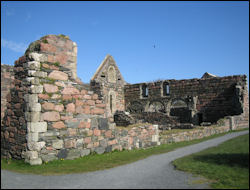
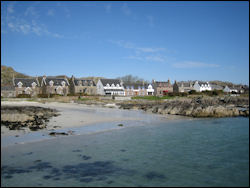
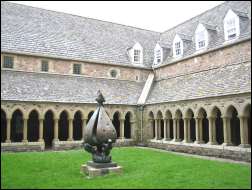
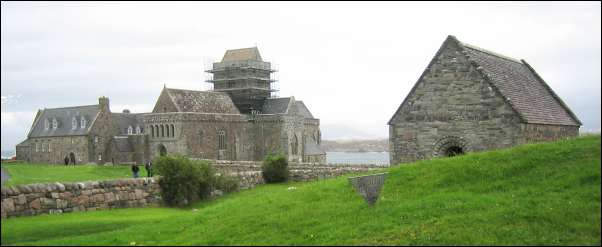
Photo copyright 2008 The Internet Guide to Scotland
Here's an extract from my journal about my visit to Iona in 1993:
The main street led up from the jetty, past the Post Office and grocer's shop. Within a few hundred metres I reached the entrance to the ruins of the nunnery dating from the early thirteenth century. All that remains today are the chancel, nave and parts of the vaulted roof of the chapel. Many old tombs can still be seen, including that of the last prioress, Anna, who died in 1543. There was a steady stream of tourists filing through on their way to the abbey. It seemed a shame that few took the time to stop and look around them, as if it was barely worthy of their attention. The ground was a carpet of short grass, with flowerbeds adding splashes of purple and red. The gardener was trimming the edges as the sun came and went. I sat on one of the benches gazing at a row of three arches edged with pale stones. The ruins were a mishmash of colours ranging from pink to grey, enclosed by a matching oblong wall. On the other side, children were playing in the school yard. At the far end, a gate opened out onto the road and I rejoined the procession of modern pilgrims reciting passages from their guide books.
The pink stone abbey rose out of the fields in front of me, as a group of workers from the religious community toiled amongst the vegetables. By the roadside, MacLean's Cross, some three metres high, stood over them watching and waiting for more of the faithful to arrive. A marker predicting the end of the journey for centuries of believers.
With a view to giving myself as much time in the abbey as possible, I thought it best to eat first and visit later, especially since I had to be back on the bus at 3.15pm. In the hopes of finding a quiet spot for lunch, I continued along the road to the northern tip of the island. After a mile or so, past the odd farmhouse, I reached a track leading through sandy fields to hidden dunes. Standing on the highest point, I could see a golden stretch of sand to my left and a group of youngsters disappearing down to what must have been another beach on the other side. Out to sea, Staffa pointed the shadowy mouths of Fingal's Cave and the Boat Cave directly at me. To the north-west, the lumps and bumps of the Treshnish Isles were clearly visible, with the outlines of Coll, Tiree, Rum and Eigg in the background. Looking back down Iona's coast, I could see the ferry crossing over to Fionnphort. In the distance I could make out my old friends the Paps of Jura, some thirty-five miles further south.
After lunch, I returned to the abbey, passing a considerable number of other walkers and day-trippers heading for the beaches. A volunteer in the reception hut handed me a leaflet and I placed some money in the donation box for the Iona Cathedral Trust.
Following repeated attacks by Norse invaders, little remains of Columba's early Christian monastery today. The present abbey dates from Medieval times. After the Reformation, it fell into ruin and the royal gravestones were almost lost under the weeds. It wasn't until the start of the 20th century that the church itself was restored when the Duke of Argyll made it over to the Iona Cathedral Trust. In 1938, George Macleod, a minister in Glasgow, founded the Iona Community and initiated the long process of reconstructing the monastic buildings.
In front of the west door stands a carved cross commemorating the fourth-century French bishop Saint Martin. Once inside the nave, the church revealed itself to be brighter than I had imagined. Yet it soon became clear that this wasn't the place for quiet contemplation and recollection, not at the height of the tourist season at least. Some tried to pray, whilst masses milled around them. I put the camcorder away. It would have been too much of an intrusion.
|
Several doors led through the north wall where there was much coming and going. I passed through to the other side and found myself in the cloisters. Warm sunlight caressed the stone curves as rows of perfect arches ran endlessly round. In the middle of the grassy quadrangle stood The Descent of the Spirit, a strange work of art (by Jacob Libschitz, a Holocaust refugee) which has been made green by the ravages of the elements. Here, few dared break the spell. I half-expected to see a hooded monk shuffle past. What secrets lay behind the upper windows, what events imprinted on the stone walls, what answers to life's questions? Just as in other cathedrals I have visited, I could feel the weight of the centuries in the air and in the very fabric of the building. Perhaps there were hidden passageways leading back into history. Scenes from Umberto Eco's Name of the Rose came to mind, as I wondered if the monks had jealously guarded their store of written knowledge. Ancient knights carved on memorial stones leant against the walls like silent witnesses. |
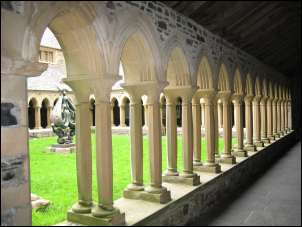 Photo copyright 2008 The Internet Guide to Scotland |
In one of the corners came the inevitable reminder of the twentieth century. Bowing their heads in single-file, the tourists trampsed over well-worn slabs leading through a tiny passageway into the cramped giftshop. In a Mecca-like swirl, we all spun around the central table of souvenir key-rings, pencil sharpeners and stickers. Lumps of polished green stone lay in a basket. This was Iona marble for which quarrying has now been stopped. At the back of the room, there seemed to be a good selection of religious and history books, but the general over-crowding soon chased me back out to the relative harmony of the cloisters.
It seemed a shame that most people, myself included, had only limited time to spend on Iona, consequently rushing to "do" the abbey and seeing little of the rest of the island. With the majority on day-trips either from Mull or Oban, it must be difficult for them to appreciate any of the real tranquillity or timelessness of the place. I felt there was much more here to which I hadn't been able to do justice. Slaves to our coach and ferry schedules, we latter-day pilgrims merely went through the motions like pre-programmed robots.
|
I went outside, past the old caretaker's house and around the back of the abbey to the infirmary, now a museum. Opening the heavy door, I found a time-switch for the lights and a room full of early Christian and Medieval stones. At one end stood the partly reconstituted form of Saint John's Cross, possibly the first ever Celtic ringed cross. Its position in front of the abbey is now occupied by a replica, whilst the shattered original is pieced together with perspex. I returned to the front of the building and noticed the sign for Saint Columba's shrine. The cell was illuminated by a single candle next to an open bible. Nearby is Saint Oran's Chapel which sits in a burial ground containing the bones of 48 Scottish kings, including Macbeth and Duncan I, together with numerous other sovereigns from Ireland, France and Norway. Legend has it that when the rest of the world sinks below the waves, Iona will remain. However, nothing very recognisable is left of the tombs today, but the chapel, dating from the eleventh century and probably the oldest building on the island, is intact. |


|
Instead of monks' voices there shall be lowing of cattle: But before the world comes to an end Iona shall be as it was Thought to be the words of Saint Columba shortly before he died
|
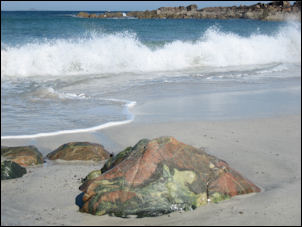 Photo copyright 2010 The Internet Guide to Scotland |
Iona Books & Maps
(As an Amazon Associate I earn from qualifying purchases)
If you would like a detailed map of Iona, get the Landranger from the Ordnance Survey which is the official map agency of the UK. It is available for online ordering via Amazon in the UK: Iona & West Mull, Ulva.

|
The Isle of Iona
One of those beautiful books which is far more than a mere guide book, but something to really treasure, this is the latest in Alastair de Watteville's series and accompanies his book on The Isle of Mull which he wrote after living on the island. His publication on Iona consists of over 120 pages with 20,000 words of text illustrated by over 160 colour photos and 20 drawings. Dimensions: approx. 12 x 8 inches. Published in March 1999. Amazon.co.uk (commission link) |

|
Iona
Set at the western tip of Mull in the Inner Hebrides, the small island of Iona is the burial place of kings and the kernel from which Christianity took root among the pagan Picts, as well as being a symbol of Scottish independence. The island was also St Columba's choice for his spiritual base in 563. This book tells the archaeological story of Iona, from Columba's monastery to the island's restoration and renewal in the late-1870s, assessing the many excavations on the island itself within the wider context of Pictland and Northumbria. Written by archaeologist Anna Ritchie as one of the Historic Environment Scotland series of books. Paperback. 128 pages. Available from Amazon.co.uk (commission link) and Amazon.com (commission link) |

|
Mull and Iona
Lovely colour guide with over 100 pages of photos. Written by P.A. MacNab, it covers the local heritage and culture of the islands, wildlife and the landscape, history of habitation, the clearances, place names, places to visit, etc. Even if you don't get chance to buy it before you go, you will certainly want a copy for a souvenir when you have visited! Available to buy online via Amazon.co.uk (commission link). Very nice addition to my bookshelf. |
|
Adomnan of Iona: Life of St Columba
Written just a century after Columba died, by the Irish monk who became Saint Adomnan, this is one of the best sources of information about Columba. Published as a Penguin Classics paperback. To order your copy, click here |
|

|
Mull & Iona: Highways & Byways
Written by Peter MacNab, this is one of the detailed b/w Luath Press guide books with maps. Excellent for discovering some off the beaten track places and historic sites not always mentioned in general Scottish guides. Includes info on where to find standing stones and wildlife. Also contains details of the main tourist attractions. Recommended if you really want to explore the island and understand its history. Paperback. 128 pages. Published in June 2000. Order your copy from Amazon.com (commission link) or Amazon.co.uk (commission link) |
Iona-Gods Energy by Rev. Norman Shanks is a 200 page paperback investigating the spirituality of the Iona community and why thousands of peeople are drawn here each year.
Where to stay
Details are correct as far as I know, but please check when booking. If you are phoning/faxing from outside the UK, then replace the initial 0 of the number with 44.
- Ardoran House - luxury B&B accommodation with sauna, spa bath and outdoor hot tub. Tel: 01681 700070. 5 minutes walk from Iona jetty.
- St Columba Hotel. Friendly, family-run hotel near the Abbey. Rooms: 9 single, 4 family, 2 double, 12 twin (all ensuite). 3 stars. Superb views, home cooking, children welcome, vegetarians welcome. Organic gardens. Telephone 01681 700304.
- Argyll Hotel on the seafront. 16 bedrooms and restaurant. Tel: 01681 700334.
- Bishop's House is a retreat house offering quiet holidays in a christian environment with daily services in St Columba's Chapel at the centre of this house with home cooked food and a peaceful atmosphere. Situated near Iona Abbey. Overlooking the Iona Sound. 13 single and double rooms. If necessary, the whole house can be rented exclusively for use by a group. Telephone: 01681 700800 / Fax: 01681 700801.
- You can also stay at the Abbey if you wish to participate in the religious life of the community. To find out more, visit the official web site for the Iona Community.
- Iona Retreats for women - part of the educational work of the Whidbey Institute and the Spirit of Legacy Program (USA).
- Shore Cottage is 3 minutes walk from the pier. 3 ensuite bedrooms (twin/double/family). Contact Sarah MacDonald - tel: 01681 700744.
- Finlay Ross Limited offers B&B accommodation just 1 minute's walk from the ferry, next to craft shop and general store. Open all year. Tel: 01681 700357.
- Calva Bed and Breakfast and Self-Catering. Situated next to the Abbey. All bedrooms ensuite. Contact Janetta Tindal. Tel: 01681 700 340.
The Iona Hostel at the north end of the islands has 5 rooms (for 2 - 6 people). 4 stars. Tel: 01681 700 781.
Self-catering accommodation is also available on the island.
Ardbeg is a self catering house for 10 people with 5 bedrooms.Visit the accommodation page of isle-of-iona.net for further details.
Or see the accommodation listings on welcometoiona.com
If you can't manage to get accommodation on Iona, then consider staying in Fionnphort on Mull - click here for accommodation list.
Links
Official tourist board free brochure
Welcome to Iona - official site
The Iona Community
Isle of Mull - Staffa - Oban